
I figured, when I started work on Season, that since I spend so much time watching football, thinking about football, and talking about football, I may as well start writing about it too. I’ve supported Norwich City since I was a boy, and two decades of delight and despair have naturally left me with a vast repository of memories and impressions to draw upon. I’m wary of trite and inflexible ‘rules’ around writing, but there is something to be said for writing what you know, and I know what it means to be a football fan.
Season was not my first attempt at writing a novel. By the time I started on the book which would become my debut, I had already drafted and discarded four or five full-length manuscripts. None of them were good enough to be published, but the process of composing and editing them taught me a lot and made me a more thoughtful writer.
With Season, the first thing I did was settle on a structure. What about a novel, I thought, which takes place over the thirty-eight games of a Premier League season, with a chapter for each match? This formal framework gave me a skeleton around which I could neatly build the narrative, which I wanted to ground in the match-day experiences of football supporters rather than focussing too much on the events of the pitch. I thought writing about two men at different life stages would help me say something about the universality of the fan experience and football’s ability to bridge social gaps, and this led naturally to the unnamed Old Man and Young Man at the heart of the novel and the friendship which develops very slowly between them.
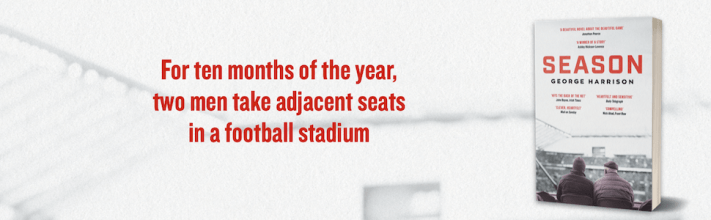
The first draft of Season was very different from the version published by Eye Books in 2025. Season had initially emerged as a short and self-conscious novella, which (I think) did a good job of capturing the mood and the spirit of the terraces but only skimmed the surface of everything else. Thankfully, this draft still had enough about it to win me an Escalator New Writer Fellowship at the National Centre for Writing. As part of the programme, I spent the best part of a year refining the manuscript under the mentorship of the novelist Michael Donkor.
The bones were already there, but Michael’s external perspective helped me get to grips with the guts of the story. I developed the characters, expanded the narrative, and teased out some themes which had previously been lurking just under the surface. But perhaps Michael’s best advice was to do with the book’s title.
 I had been going with the clunkier and far less poetic Season Ticket, until Michael suggested I ‘drop the Ticket.’ Sometimes, in football, you know a shot is going in as soon as it leaves the striker’s boot, and this suggestion had the same feeling about it. In that moment, Season was born, and I knew then that I was on to a winner.
Season was shortlisted for the Nero Book Award for best Debut Fiction, published by Lightning Books.

 Cull & Co. Literary Agency Ltd