
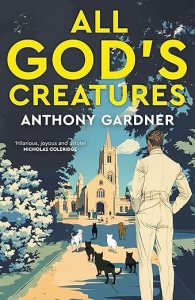
All God’s Creatures is not a book I intended to write. It’s a prequel to my novel Fox, published in 2016, which at the time seemed complete in itself. Gradually, however, events got the better of me.
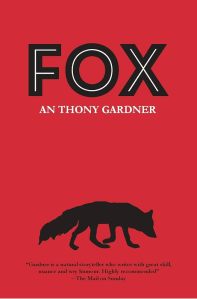 Fox was a satirical thriller about urban foxhunting and Chinese spies which proved weirdly prescient, since it involved a mass-surveillance system developed in Beijing and a virus whose spread the government was struggling to control. A minor strand focused on a militant religious movement called All God’s Creatures, which held that animals should be allowed to receive Holy Communion. The disruption it caused allowed the Prime Minister – under pressure from the Beijing government – to threaten the mass closure of churches unless the Archbishop of Canterbury denounced an underground Christian movement in China.
I gave little thought to All God’s Creatures over the next few years. But as the forces of political correctness gathered, I couldn’t help seeing parallels with some of the new movements that were sweeping the world. Suppose the All God’s Creatures creed actually was widely accepted and anyone who disagreed with it was cancelled: how, I wondered, might that come about? So I set to work on the story of Ben Fairweather, the editor of a religious magazine called Cathedral which is taken over by All God’s Creatures. As a result, Ben finds himself thrown into a world of Russian spies, art forgery and murder.
Ben’s experiences were based partly on my own. Like him, I’d worked on magazines turned upside down by mad directives from above. Like him, I’d mourned the death of a dog and speculated on whether animals go to heaven – the inspiration for a Cathedral article which draws the attention of predatory forces. And though, unlike him, I lack the skill to pursue a second career as a nightclub pianist, it’s something I’ve occasionally fantasised about.
 In its original form All God’s Creatures was – at 39,000 words – very short: too short. How could I make it more substantial? As the plot involved a forged painting, I hit on the idea of a back story for it: who had painted it and why. It happened that my wife and I had made several visits to St Ives so that she could study at its art school; while we were there, a local friend mentioned that people in witness-protection schemes were often settled in Cornwall because it was so far from London. So Kevin Murphy, a former gang member who discovers a gift for painting, joined the cast of characters. Weaving his story into the existing narrative was far from easy, but added to the richness of the novel.
Satire, like much of fiction, is a way of taking revenge on an unsatisfactory world, and in writing it I’m spurred on by things that annoy me. The targets in All God’s Creatures include Russian oligarchs, art curators and pretentious language. The novel’s main purpose, however, was to explore the way that fanatics can take reasonable ideas and push them to insane extremes. I hope that readers will find it thought-provoking as well as funny and exciting.

 Cull & Co. Literary Agency Ltd