I wrote Timebomb by accident.
On the hundredth anniversary of Henry Moseley‘s death, in 2015, a flurry of history podcasts came out about his life and legacy. Because of my physics degree, I was familiar with the broad strokes: he was a brilliant young British atomic physicist, considered a shoo-in for the Nobel prize for his work on nuclear charge. He volunteered for service in World War One and lost his life to a sniper’s bullet at Gallipoli.
I listened to the podcasts with interest. I’d always been fascinated by Moseley’s tragic story as a cautionary tale about the dangers of conformity to societal expectations, particularly as they relate to gender. Although he could have been infinitely more useful to the war effort as a scientist (for example, his mentor Sir Ernest Rutherford put his skills to work developing anti-submarine acoustic technology), Moseley instead signed on as a soldier, insisting that as an able-bodied man it was his duty to be exposed to the dangers of combat. As a result, perhaps the finest scientific mind of his generation was snuffed out before he reached his 28th birthday.
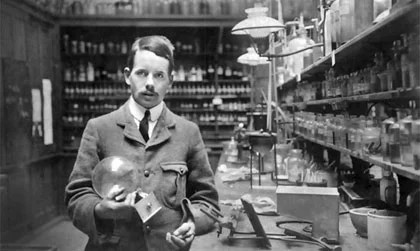
The podcasts also revealed a fresh detail about Moseley. Just before departing for the war, he had written his mother a letter, saying that he would soon be sending her a scientific notebook, adding “I value it highly”. This notebook, the podcasts told me, had subsequently vanished.
My first thought was that this sounded like the premise of exactly the kind of novel I enjoy reading: an historical mystery with high stakes and the potential for international intrigue and skulduggery. My second thought was that somebody MUST have already written it.
When I discovered that no fictionalised version of Henry Moseley’s life existed, I began to imagine what the plot of such a story would look like. A notebook belonging to a brilliant atomic physicist had gone missing. What secrets might it have contained? Who would have been interested in acquiring these secrets? And how did the notebook disappear?
I kept my wife apprised of the progress of my imaginary novel as the plot gradually took shape in my head. Liz, herself a writer, encouraged me to write the thing, but no, I was only playing with ideas. Writing novels was something that other people did, and anyway, a novel was a huge undertaking. Who has that sort of time?
Several months passed, during which I continued to “play” with the plot of my never-to-be-written novel. I also read up on such diverse topics as conscientious objectors during World War One, the history of policing in the UK, atomic physics, and, oddly enough, whippet racing.
Eventually, it became clear to me that I was no longer simply playing at writing a novel. I’d created a workable outline and done extensive research. All that remained was to begin actually putting words on the page. I sat at my computer, took a deep breath, and started typing.
The journey from blank page to publication has not been a short one. What with writing, researching, and seemingly endless revisions, it has been a much longer road than I’d naively expected when I first started. For me, though, the time and the effort have been worthwhile. I hope that readers of Timebomb will feel the same way.
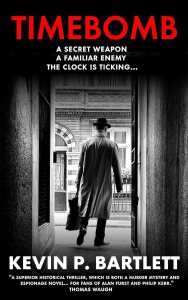
Timebomb is out now, published by Sharpe Books.
 ‘A superior historical thriller, which is both a murder mystery and espionage novel…for fans of Alan Furst and Philip Kerr.‘ – Thomas Waugh
It’s working title was HENRY’S BOMB, which was shortlisted for the 2022 Debut Dagger award and for the 2020 “Unhanged Arthur” award for best Canadian unpublished crime manuscript. It was also a finalist for the 2022 Killer Nashville Claymore award in the “Best Thriller” category
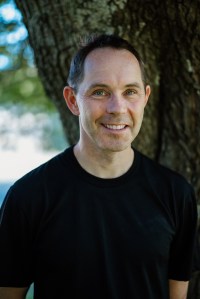
Kevin Bartlett was born in Colchester. He lives in Victoria, Canada, with his wife. He has degrees in both history and physics. He has lived in the United Kingdom, France, Germany, Japan, and the United States, working at particle accelerators, an astronomical observatory, and as a scientific fisheries observer.
Timebomb is his first novel.

 Cull & Co. Literary Agency Ltd